What Makes Basement Junk Removal Hard: The Stairs
Every basement job comes down to one staircase. Most have a low header you have to duck, a wall on both sides and a tight turn at the top into the kitchen or a back hall. A couch that went down fifteen years ago has to come back up the same way, and nobody remembers how it fit.
Some things were never carried down whole. Treadmills, entertainment centers and big desks often got assembled downstairs out of flat boxes. They go back up in pieces.
That's normal work for us. Here's how the usual problem pieces come out.
Couches and recliners are the pieces that fight the hardest on a staircase. If one of those is all you've got, our single couch pickup is a quicker booking.
| Basement item | How it gets up the stairs |
|---|---|
| Sleeper sofa | Cushions and mattress come out first. If it still won't turn the corner, the fold-out frame unbolts. |
| Sectional | Unhooked into separate pieces and carried one at a time. |
| Treadmill or elliptical | Console and uprights come off. The deck goes up on its edge. |
| Chest freezer | Emptied, thawed, lid taped shut, then stood on end. |
| Entertainment center or wall unit | Taken apart panel by panel and bundled. |
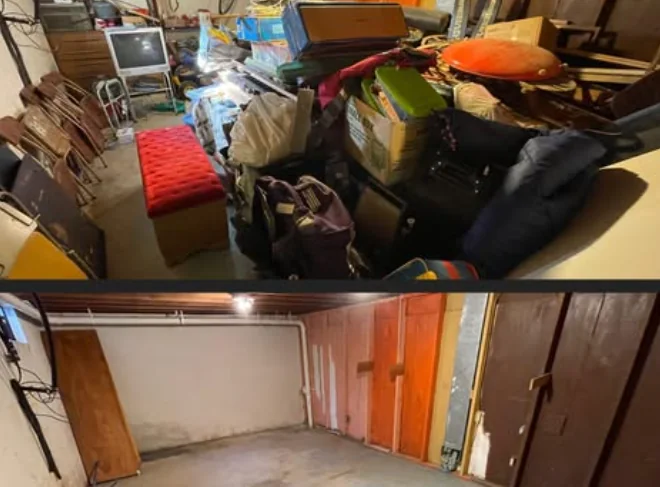
Basement Cleanouts in Waukegan IL: What We Haul Up and Out
Basements collect the heavy stuff. It's the room where things go when they still sort of work but nobody wants to look at them. Around Waukegan and the rest of Lake County, a typical load looks like this.
- Old couches, recliners, bar stools and the freestanding basement bar
- Mattresses, box springs and bunk bed frames
- Chest freezers, spare fridges, washers, dryers and dead water heaters
- Tube TVs, stereo cabinets, computer monitors and tangled boxes of cords
- Treadmills, weight benches and stationary bikes
- Metal shelving, filing cabinets and workbenches
- Boxes of books, toys, clothes and holiday decorations
- Carpet, pad and paneling that's already been pulled up
Unhook It First: Water Heaters, Washers, Dryers and Freezers
We carry and haul. Anything tied into your plumbing, gas or wiring needs to be disconnected before we get there.
Fridges, freezers and dehumidifiers all have refrigerant in them. It has to be recovered before the metal can be scrapped. That happens after pickup, not in your basement.
| Appliance | Have this done before pickup | Why it matters |
|---|---|---|
| Water heater | Gas or power off, lines disconnected, tank drained | A full tank is too heavy and too wet to carry up a staircase |
| Washer | Water shut off, hoses unhooked and emptied into a bucket | Leftover water ends up on your stairs |
| Gas dryer | Gas shut off and the line capped by someone qualified | An open gas line is not something to leave for later |
| Chest freezer or fridge | Emptied and unplugged a day ahead, lid propped open | It needs to thaw and drain before it gets tipped |
| Dehumidifier | Unplugged, bucket emptied | It holds refrigerant, so it gets handled like a fridge |
How to Sort a Basement Into Keep, Donate and Haul
Do the sorting before pickup day, not during it. Decisions come easier when there isn't a truck waiting in the driveway.
Not sure about something? Leave it in the keep corner. It's easy to add one more chair to a later pickup. It's impossible to get one back.
- Carry the keepers upstairs if you can. If you can't, stack them in one corner and throw a bedsheet over the pile. Covered means it stays.
- Open every box. Basements are where photo albums, tax records and kids' school papers end up, and a box marked CHRISTMAS isn't always Christmas.
- Use painter's tape on anything big that's staying, like the good freezer or the furnace-room shelving.
- Check under the stairs and in the back of the furnace room. That's where paint cans and old chemicals hide, and those can't come with us.
- Skip the donation pile unless you plan to drop it off yourself. Usable things get pulled for donation after every pickup.
- Replace any burned-out bulbs. A dark basement slows everything down.
Wet Boxes, Musty Carpet and Old Floor Tile
If your basement has ever taken on water, some of what's down there is ruined. Soaked cardboard, swollen particleboard furniture and moldy carpet all go on the truck. Bag what you can, because wet boxes fall apart on the stairs.
We haul it out and sweep up. We're not a cleaning service, so scrubbing, drying and mold treatment are a separate job for someone else.
One caution for older homes. Some old floor tile and the wrap on old heating pipes can contain asbestos, and asbestos is on our can't-take list. Don't scrape up old tile or strip pipe wrap to get the room ready for us. Leave it alone and have it tested if you're not sure.
Already tore out the paneling, the drop ceiling or the carpet for a remodel? That's remodeling debris hauling, and it rides on the same truck as everything else.
Pickup Day: How the Basement Carry-Out Works
Before we get there, take the pictures off the stairwell wall and clear the shoes and laundry baskets off the steps. Roll up the rug at the top. A bare staircase is the single biggest favor you can do the crew.
We start with a quick walk through the basement so we know what stays. Big pieces usually go up first, while the staircase is clear and there's room to turn them. Boxes, bags and loose items follow.
If you have a walkout door or an outside stairwell, tell us. That's almost always a better way out than through the kitchen.
When the basement's empty we sweep the floor and the stairs. You don't need to be around for any of it, as long as we can get in and the keep pile is marked. To get on the schedule, send us a photo of your basement or text it to (224) 944-8652.
What Basement Junk Hauling Is Priced On: Truck Space, Not Stairs
You pay for how much of the truck your stuff fills. A quarter, a half, three-quarters or a full truck. The carrying, loading, sweep-up and disposal are part of that number.
People expect a basement to cost extra because of the stairs. It doesn't. There's no stairs fee, no hourly rate, no weight fee and no fuel surcharge. You see the price and approve it before we start. Our flat-rate pricing breakdown explains the load sizes.
For most basements a few photos get you a number by text. For a packed one, we'll stop by for a free look that takes about 15 minutes.
Basement Items That Have to Stay Behind
A short list of things can't go on a junk truck: wet paint, solvents, motor oil, gasoline, propane tanks, asbestos, ammunition and medical waste.
Basements usually have the paint. If the cans are still liquid, Lake County residents can take them to SWALCO, the Solid Waste Agency of Lake County, which runs household chemical waste collection. Across the line in Wisconsin, look up your county's household hazardous waste collection.
Set those things aside in one spot so nobody grabs them by mistake. Everything else in the room is fair game.
Where Basement Junk Goes After It Leaves Your House
Nothing gets dumped in one pile. The load is sorted once it's off your property. Furniture and household goods in decent shape go to donation. Metal, like shelving, bed frames and appliance shells, goes to scrap recycling.
The electronics get dropped with an electronics recycler. Illinois and Wisconsin both keep TVs and computers out of landfills, which is why that old console TV can't just go in the trash. Whatever's left after sorting goes to a licensed transfer station.
If you're clearing the top of the house too, attic clean outs can be booked for the same visit.
Basement Junk Removal Across Lake County IL and Into Wisconsin
Our home base is Waukegan. Inside Lake County there's no extra charge for distance, so the far corners of the county get the same pricing as the house next door to us.
To the north, we do basement hauling in Winthrop Harbor, the last Illinois town before the state line.
At the south end of the county, basement junk pickup in Lincolnshire works exactly like it does here. Same photo quote, same flat price.
We also go about a 30 minute drive past the Wisconsin line. For a basement clean out in Mount Pleasant, over in Racine County, your price is confirmed by text before the truck leaves.
We're on the road Monday through Saturday, 7am to 7pm, and Sundays by appointment. There's often a same-day or next-day slot open.